
F-35

David Axe, China, Russia Could Make U.S. Stealth Tech Obsolete:

It’s been a pillar of the U.S. military’s approach to high-tech warfare for decades. And now, it could become obsolete in just a few years.  Stealth technology — which today gives U.S. jets the nearly unparalleled ability to slip past hostile radar — may soon be unable to keep American aircraft cloaked….

“In recent years there has been speculation that ongoing advances in radar detection and tracking will, in the near future, obviate the ability of all-aspect, low-observable aircraft such as the B-2, F-22 and F-35 Joint Strike Fighter, aka JSF, to survive inside denied airspace,” Watts writes, referring to America’s stealth bombers and fighter jets.

Stealth-killing advances include VHF and UHF radars being developed by Russia and China, and a “passive-detection” system devised by Czech researchers. The latter “uses radar, television, cellular phone and other available signals of opportunity reflected off stealthy aircraft to find and track them,” Watts explains.

These new detection systems could reverse a 30-year trend that has seen the U.S. Air Force gain an increasing advantage over enemy defenses….
Continue reading

Weekly Digest – June 22, 2014

Must Read

Should Read

Continue reading

Mortality Rate vs Survival Rate

Aaron Carroll, Zombie arguments defending the US healthcare system:

There’s a new Commonwealth Study that ranks the US [healthcare system] pretty poorly. Nothing new there. Nothing new to some of ways that people defend the US. So let’s dispense with them in rapid fashion…

He makes three points, one of which is that when evaluating the effectiveness of a country’s healthcare system mortality rates (mortality rate = deaths per year per 100,000 people for a specified illness) are a better measure than N-year survival rates (survival rate = the probability that you’ll be alive N years after diagnosis).  It’s not that survival rates are irrelevant in the grand scheme of things, just that they’re not a good measure of how effective a healthcare system is.   Here’s his explanation for why mortality rates are more relevant than survival rates:

Thought for the Day: 17 June 2014

What Orwell feared were those who would ban books. What Huxley feared was that there would be no reason to ban a book, for there would be no one who wanted to read one. Orwell feared those who would deprive us of information. Huxley feared those who would give us so much that we would be reduced to passivity and egoism. Orwell feared that the truth would be concealed from us. Huxley feared the truth would be drowned in a sea of irrelevance. Orwell feared we would become a captive culture. Huxley feared we would become a trivial culture, preoccupied with some equivalent of the feelies, the orgy porgy, and the centrifugal bumble puppy.

–  Neil Postman, Amusing Ourselves to Death


“If you want to know whether things like the 2009 stimulus bill and the various iterations of quantitative easing have worked, this is the comparison you need to look at.”

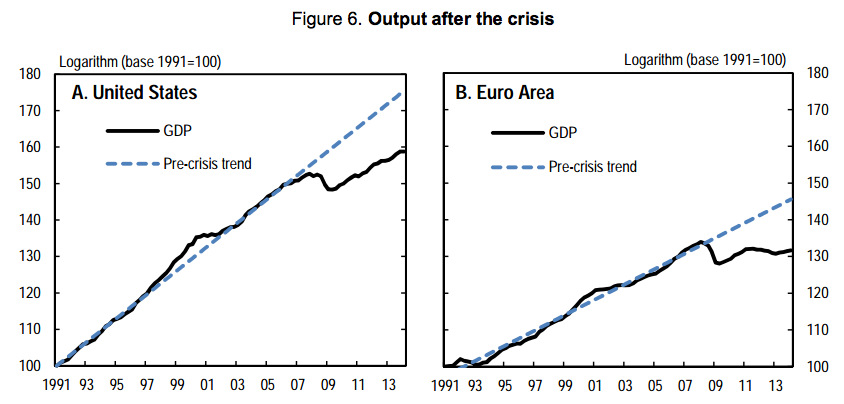
Brad DeLong points us to Matt Yglesias, The US recovery has been a disaster; the eurozone’s has been much worse:

As this chart from the OECD’s new report on the US economy shows, the economic recovery in the United States has been incredibly weak.

Screen_shot_2014-06-13_at_11.50.26_am

But it’s also been enormously stronger than the recovery in the eurozone. If you want to know whether things like the 2009 stimulus bill and the various iterations of quantitative easing have worked, this is the comparison you need to look at. Have they worked to make the economy healthy? No. Have they worked to make the economy healthier than it’s been in the place where they didn’t do that stuff? Absolutely.

There’s no such thing as a well-controlled experiment in macroeconomics.   This is about as you’re ever going to see.   The US enacted a modest stimulus.  In contrast, Europe went all in for austerity.   Modest stimulus won.


Weekly Digest – June 15, 2014

Must Read

In the five years since the United States began its slow climb out of the deepest recession since the 1930s, the job market has undergone a substantial makeover. The middle class has lost ground as the greatest gains have occurred at the top and bottom of the pay scale, leaving even many working Americans living in poverty. The housing industry, once the primary engine of growth and a fountain of jobs, has shrunk, while health care, technology and energy have led the recovery.

In an unusual, perhaps unprecedented move, leaders from across the health care industry [in Massachusetts] are calling for closer scrutiny of a deal that would cap prices for Partners HealthCare in the short term but would let the state’s largest hospital network add four more hospitals.

The deal that is fueling letters, analysis, statements and meetings is between Partners HealthCare and [Massachusetts] Attorney General Martha Coakley.  She says it will limit Partners’ clout and the health care “Goliath’s” (her word) ability to drive up costs. That might be true. But no one has seen any details. The only thing made public is a press release…. Coakley has said that the details would be available when the agreement is filed in court.

Unless Congress appropriates new funds at some point in the next year, coverage for millions of children will lapse in September 2015.  The Children’s Health Insurance Program (CHIP) covered 5.7 million children in 2009. It was enacted by President Clinton in 1997 and was temporarily reauthorized under President Obama during his first year in office.  But funding for the program expires at the end of September 2015….

Due to a mistake in the way the Affordable Care Act was written, an estimated two million children will be without affordable coverage if Congress fails to continue CHIP’s funding. The mistake, known in health policy circles as the “family glitch,” prohibits families with incomes below 400 percent of the federal poverty line from receiving subsidies if one of the parents has health insurance through their employer – even when that coverage won’t cover dependent spouses or children.

Should Read/Listen

Economics Continue reading

ABC (“Anyone but Coakley”)

A request:  If you’ll be a delegate at this weekend’s Democratic state convention then please vote for one of the candidates other than Martha Coakley when you vote to endorse a candidate for governor.   Actually, please vote for whoever appears to be in second place so that there will be at least two candidates on the primary ballot this September.

For those not in the know, Democratic candidates for governor must receive at least 15% of delegate votes at the state convention in order to get on the primary ballotCoakley currently leads Treasurer Steve Grossman 49% to 14% according to a recent poll.   (The other three candidates only have low single-digit support.)  I have no idea how that translates into support amongst convention delegates but I really don’t like the thought of an uncontested primary.  Not to be coy, it’s not just the thought of an uncontested primary that bothers me.  I just plain don’t care for Martha Coakley.

Why don’t I like Coakley as a candidate?  Simple:  I listen to her speak and visit her website and what immediately comes to mind is “Poll-tested platitudes.”  I’ll elaborate.

Continue reading

Eight criticisms of Pres. Obama

Commenter Richard Genz offers the following criticisms of Pres. Obama on Krugman’s blog:

  1. Capitulation to Wall Street as seen in the easy conditions for bailout money. Loyalty to [former Treasury Secretary Tim] Geithner. Backing down from Elizabeth Warren at CFPB.  [Note:  That worked out for the best with Warren though.  If she’d been appointed head of CFPB then it’s very unlikely we’d have her as our senator.]
  2. Slow walking US climate leadership, in fact, not leading at all until 6 years in.  [Note:  See this interview with Obama advisor John Podesta.]
  3. Acceptance and promotion of most damaging fallacy that government must tighten its belt like households must do
  4. Lending credence to “grand bargain” strategy to unwind Social Security and Medicare [Note:  Paul Krugman weighs in on the subject.]
  5. Gross incompetence in managing government agencies: HHS w/ healthcare.gov and now the VA. Very slow to enforce discipline and integrity at US agencies by shaking up staff
  6. Allows FCC to float Internet rules to favor corporate giants
  7. Allows Eric Holder to continue avoiding real prosecution of financial crimes like mortgage fraud, tax evasion, money laundering, rate-rigging  [Note:  See Matt Taibbi on Holder and the Justice Dept. here and here.]
  8. Failure to understand dynamics of American oligarchy

I’d probably drop #8 because a) the charge is a bit abstract and b) I think he does understand but is not inclined to challenge it.  Other than that though it’s a pretty solid list.  I would add to the list Obama’s hesitation to reign in domestic surveillance by the NSA.

Continue reading

Mississippi GOP Senate primary

You’ve probably heard that there will be a run-off between Sen. Thad Cochran and challenger Chris McDaniel.  From the NY Times:

Some say the differences between the supporters of Mr. Cochran, a senator since 1978, who is the face of the party establishment, and those of Mr. McDaniel, a former host of a conservative radio show, go beyond the issues in the race.

“There’s a divide between the ‘country club’ Republicans and what I call the ‘deer camp’ Republicans,” said Jon C. Lewis, a Hinds County constable, who, as a McDaniel supporter, puts himself in the latter camp. “Their problem is that there’s more of us than there is of them.”

Charlie Pierce observes:

This is a political divide that goes back at least as far as the old Civil War aphorism, “Rich man’s war, poor man’s fight,” that was the mantra of Confederate soldiers when discussing the plantation aristocracy that the grunts saw has having led them into the cannons at Gettysburg. That divide never truly closed.

Pierce goes on to describe a filibuster of the Armed Ships Bill in 1917 (lead up to WWI) as an example of how the divide played out in Mississippi politics a century ago.  Worth reading.