Weekly Digest – June 29, 2014
Must Read
- John Tirman, The Legacy Of Unlearned Lessons, And The Current Crisis In Iraq
- Joseph Stiglitz, Inequality Is Not Inevitable
- Jonathan Franzen, Mr. Difficult
Should Read
- Mark Mazzetti, Use of Drones for Killings Risks a War Without End, Panel Concludes in Report (The report: Recommendations and Report of the Task Force on U.S. Drone Policy)
- Martha Bebinger, [Massachusetts Attorney General Martha Coakley’s] Deal With Partners Filed In Court: Restricts Growth, Costs
- David Epstein, Still time to plant vegetables and perennials, but some things need to wait
- Katie Valentine, Don’t Forget Butterflies! Our Pollination Crisis Is About More Than Honeybees
- Charlie Pierce, The Problem With The Environment
- Hank Paulson, Lessons for Climate Change in the 2008 Recession
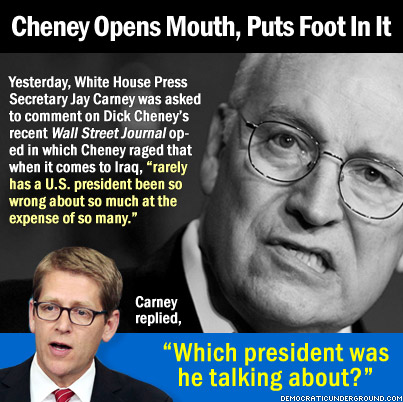
“Which President was he talking about?”
Music for Saturday night
MIT Tech Day 2014: The Future of Planet Earth
Videos of this year’s speakers here.
The talks:
- “Earth Under Stress: Thinking differently about climate research” — Kerry Emanuel ’76, PhD ’78, Cecil & Ida Green Professor of Atmospheric Science:
For the past half century, scientists have been at work on amassing an impressive array of data and models to understand the stresses placed on the planet by an accelerated rate of climate change. This talk will assess the current understanding of the major climate processes and propose new directions for climate research.
- “Lessons from the Landscapes of Earth and Other Planets” — Taylor Perron, Cecil and Ida Green Assistant Professor of Geology:
Landscapes are open archives of planetary history. Looking elsewhere in the solar system and into Earth’s past shows that some landscape features are surprisingly robust. But the specific forms they take on appear to depend on life and, more recently, on human impacts. This talk will explore clues left in planetary landscapes and the light they shed on the state of the planet.
Truman
a voice from the rustbelt, “wild greed”:
As a senator from Missouri in 1937 Harry Truman railed against the Wall Street, and ‘gentleman’ lawyer greed that was behind the re-organisation of the railroads. The following excerpt was from his second speech on the topic. In the first speech, in June, he contrasted the $3,000 that Jesse James stole from the Rock Island Line to the $70,000,000 financial artists got away with.
“…We worship money instead of honor. A billionaire, in our estimation is much greater in these days in the eyes of the people than the public servant who works for public interest. It makes no difference if the billionaire rode to wealth on the sweat of little children and the blood of underpaid labor. No one ever considered Carnegie libraries steeped in the blood of Homestead steelworkers, but they are. We do not remember that the Rockefeller Foundation is founded on the dead miners of the Colorado Fuel and Iron Company and a dozen other similar performances. We worship Mammon; and until we go back to ancient fundamentals and return to the Giver of the Tables of Law and His teachings, these conditions are going to remain with us.
It is a pity that Wall Street, with it’s ability to control all the wealth of the nation and to hire the best law brains in the country, has not produced some statesmen, some men who could see the dangers of bigness and of the concentration of the control of wealth. Instead of working to meet the situation, they are still employing the best law brains to serve greed and self interest. People can only stand so much and one of these days there will be a settlement….”
—Senator Harry Truman, December 20, 1937
Congressional Record, seventy-fifth Congress, second session, volume 82, part 2, December 20, 1937. pp. 2482-95.
Music for Friday night
Strong Motion
Fiction and non-fiction:
- Jonathan Franzen, Strong Motion
- AP, Ohio regulators halt fracking site, drawing link to quakes
- Mother Jones, Fracking’s Latest Scandal? Earthquake Swarms
- State Impact, How Oil and Gas Disposal Wells Can Cause Earthquakes
Robert Kuttner, Three Reasons Liberals Lack Traction With Voters, Despite Conservative Failures
Robert Kuttner, Three Reasons Liberals Lack Traction With Voters, Despite Conservative Failures:
Today’s conservatives have a problem. The middle class is increasingly anxious about its economic prospects, and with good reason. Inflation-adjusted earnings have declined for most people since 2000, long before the collapse of 2008. Young adults face more than $1.2 trillion in college debt, declining entry-level salaries, high costs of housing and childrearing, and dwindling employer health and pension benefits.
With new public attention being paid to inequality of income and wealth, these concerns don’t exactly play to conservative strength. The era since 1981 has been one of turning away from public remediation, toward tax cuts, limited social spending, deregulation, and privatization. None of this worked well, except for the very top. For everyone else, the shift to conservative policies generated more economic insecurity. The remedies are those of liberals’… If conservatives offer little that’s credible to the anxious middle class, why aren’t liberals just trouncing them?
First, the right has been so successful at blocking liberal initiatives to deliver tangible help that the middle class is not sure which party to trust.
Second, compromises like the Affordable Care Act that do make it through Congress are hobbled by a costly and complex role for commercial middlemen—and seem to represent government inefficiency.
And third, the details are wonky. This exercise is more about slogans and headlines. Only a tiny fraction of voters will notice the holes in the specifics. So despite such empty rhetoric, Republicans are poised to win the midterm elections.
So what’s a liberal to do?
As the party that considers itself responsible stewards of government, Democrats are reluctant to offer proposals that stand no immediate chance of passage. The liberal imagination has been stunted by decades of conservative obstruction and has lost its power to inspire. Most of what ails the middle class requires far more robust policies than are currently in mainstream debate. Liberals should say what they are really for. They might even win more followers.
Scaling factor for thin plate smoothing spline?
I have a problem which may benefit from the application of a thin plate smoothing spline. I need to interpolate values on a 2-d grid where I have sparse data. The thin plate kernel is the basis for the spline solution. In 2-d the solution corresponds to
(1) ![\begin{eqnarray*} \lefteqn{ \min_{\beta, \theta} \Big( \sum_{i=1}^n{ \left[ y_i - f_i( \beta, \theta) \right]^2} + } \nonumber\\ & \lambda \int_{u,v} \left( \frac{\partial^2f}{\partial u^2} \right)^2 + 2 \left( \frac{\partial^2f}{\partial u \partial v} \right)^2 + \left( \frac{\partial^2f}{\partial v^2} \right)^2 \mathrm{d}u \mathrm{d}v \Big) \end{eqnarray*}](http://www.robustanalysis.net/wp-content/ql-cache/quicklatex.com-8ae38dd5b82ffa83e1706dac4d394550_l3.png "Rendered by QuickLaTeX.com")
where  are data values and
  is the model function. Once the maximum likelihood parameter values have been determined
  is used to generates y values at all spatial positions,
  .
.
Long story short, in the thin plate model the integral in Eq.(1) is reduced to sum over reproducing kernels
(2) 
where ![\mathbf{x} = \left[ u,v \right]](http://www.robustanalysis.net/wp-content/ql-cache/quicklatex.com-ac8158e581d7b5c0dff02e46d7589401_l3.png "Rendered by QuickLaTeX.com") are spatial coordinates,
are spatial coordinates,  are control points and
  is the Euclidean norm of
  .
.
Referring back to Eq.(1), the minimization process determines the weight coefficient for each of the kernel functions as well as a DC offset and the coefficients for two linear terms in  . For a given
  value, the number of parameter values to be estimated is equal to the number of control points plus three. Use Generalized Cross-Validation (GCV) to determine the optimum value of .
The thin plate formulation, i.e., the reproducing kernel element of it, is nice because it allows you to determine parameter values using matrix math that you do for maximum likelihood estimation. I get the general form of the solution. (Follow the link above if you want the details.) What I’m stuck is that there’s no scaling parameter in Eq.(3). More specifically, why isn’t the kernel function
(3) 