On the responsibility of scientists in the age of climate change

From Michael Mann’s editorial, If You See Something Say Something:

If scientists choose not to engage in the public debate, we leave a vacuum that will be filled by those whose agenda is one of short-term self-interest. There is a great cost to society if scientists fail to participate in the larger conversation — if we do not do all we can to ensure that the policy debate is informed by an honest assessment of the risks. In fact, it would be an abrogation of our responsibility to society if we remained quiet in the face of such a grave threat.

This is hardly a radical position. Our Department of Homeland Security has urged citizens to report anything dangerous they witness: “If you see something, say something.” We scientists are citizens, too, and, in climate change, we see a clear and present danger…

The urgency for action was underscored this past week by a draft United Nations report warning that another 15 years of failure to cut heat-trapping emissions would make the problem virtually impossible to solve with known technologies and thus impose enormous costs on future generations. It confirmed that the sooner we act, the less it will cost.

How will history judge us if we watch the threat unfold before our eyes, but fail to communicate the urgency of acting to avert potential disaster? How would I explain to the future children of my 8-year-old daughter that their grandfather saw the threat, but didn’t speak up in time?

Those are the stakes.

Links:


On-Line Education: “Global Warming: The Science of Climate Change”

Offered by Coursera:

Global Warming: The Science of Climate Change:

This class is an introduction to the science of global warming for students without a science background. Students will examine the evidence surrounding climate change from a variety of perspectives and approaches, and, in the process, gain a multidisciplinary understanding of the scientific process.

The instructor is University of Chicago professor David Archer.  I registered the other day.  This will be interesting.  I have no experience with on-line education.  In addition to an on-line class being a new experience, I should know most of the material very well but I also expect I’ll discover some big gaps in my knowledge.  (It’ll be interesting to learn where those gaps are and to try to fill them.)

Additional detail on the class from Coursera’s website:

Continue reading

Global Energy Balance: Where the Sun’s Energy Goes. What Drives Climate and Climate Change.

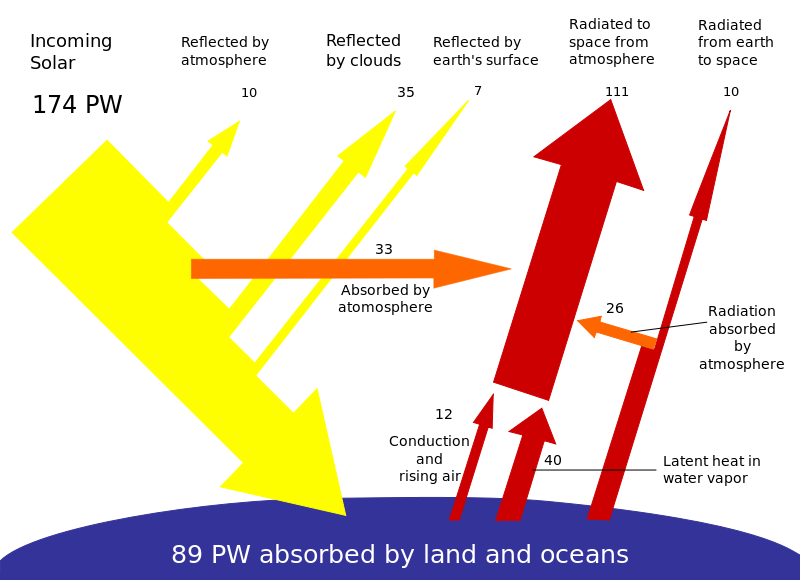
The figure below shows where incoming solar energy goes, i.e., how much is reflected and absorbed by the air in the atmosphere, by clouds, by the Earth’s surface, etc., and what becomes of what’s absorbed.  The disposition of solar radiation in combination with infrared (IR) emission from the Earth’s surface and the atmosphere are what govern planetary temperature and drive climate change.  The numbers in the figure below are petawatts:  1 PW = 1,000,000,000 megawatts.  For comparison, nuclear power plants generate on the order of 1,000 megawatts.

Breakdown_of_the_incoming_solar_energy.svg

Looking at the numbers, you see that the biggest driver is radiation (emission of IR light) to space from the atmosphere.  Also significant, but less so by at least a factor of three, are heating of atmospheric water vapor, reflection by clouds, and absorption by the atmosphere.   We expect that the Earth’s temperature will be particularly sensitive to things (human activities and natural phenomena) which affect those processes.  Increase in atmospheric carbon dioxide (CO2) concentration is particularly significant because it affects the Radiation to Space from Atmosphere mechanism.   CO2 functions as a blanket which retains heat at lower altitudes.

Continue reading

Evidence for human-induced climate change

I found this list of evidence and associated references on-line in fall 2012.  I don’t recall where or the original author of the post.  Reprinted here as a public service:

  1. Atmospheric CO2 is rising, and its isotope composition matches fossil carbon. CO2/O2 ratio is also changing in a way that is consistent with our burning of fossil fuels.  Reference:  Manning, A.C., Keeling, R.F., “Global oceanic and land biotic carbon sinks from the Scripps atmospheric oxygen flask sampling network,” Tellus, vol. 58, p. 95–116 (2006).
  2. Less heat is escaping to space. In a warming world, this evidence excludes every cause but the enhanced greenhouse effect. In addition, the changes in frequency spectrum also point CO2 and CH4 as the causes of the change. Ref.:  Harries, J. E., et al (2001). Increases in greenhouse forcing inferred from the outgoing longwave radiation spectra of the Earth in 1970 and 1997,” Nature, vol. 410, p.355-357.
  3. Continue reading

Weekly Digest – October 1-7, 2012

Taxation:

Matters of law:

Vote suppression and voter disenfrancisement:

Miscellaneous:

Economy (trying to end on a positive note):