UPDATED 12/13/14.
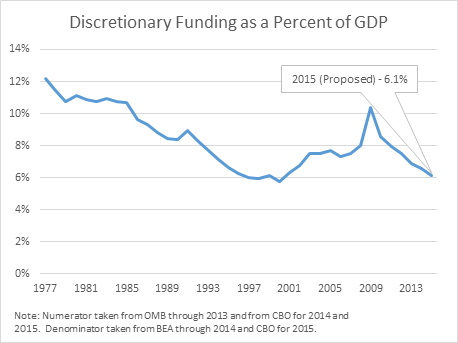
Source: Jared Bernstein, Who you callin’ massive? The CRomnibus actually cuts discretionary spending to historic lows as share of GDP

UPDATED 12/13/14.
Source: Jared Bernstein, Who you callin’ massive? The CRomnibus actually cuts discretionary spending to historic lows as share of GDP
Harry Shearer has a internet TV show, Nixon’s the One. He takes dialogue verbatim from Nixon’s Oval Office recordings and creates accompanying visuals. Here’s a recent episode, “Elites”. Remember, what you hear actually happened. (What gets me most is how insecure he sounds.):
… Maybe you can help me understand this argument, people say opposition to [Treasury Undersecretary for Domestic Finance nominee Antonio] Weiss is unreasonable because, wait for it, he likes poetry,” Warren said. “I’m actually not kidding on this one. Supposedly because he helps publish a literary magazine called the Paris Review we should trust that he will zealously pursue financial reform. Now I confess, I don’t read many literary magazines but, really?”
Not only does Weiss like poetry but he’s also a trustee of Frick Collection. Civilized people simply do not oppose poetry-loving Frick trustees. It doesn’t matter what the job is. It’s simply not done. She’s a senator for goodness sake. What part of “advise and consent” does she not understand? (“Consent”, Senator. “Consent.” Don’t be a such a buzzkill.)
I’m with Charlie Pierce:
I still will stand with Governor Dean and the 50-state strategy, at least applied judiciously. To me, the key to the problem is to break the stranglehold of the Washington- based consultant class over what candidates will be run in what places. It wasn’t the Beltway crowd who found Jon Tester in Montana, or Jim Webb in Virginia. [Ed.: It wasn’t the Beltway crowd who found Elizabeth Warren either.] The national party should be involved in these races only as a means by which money can be shrewdly spread around, and as a means of employing some sense of party discipline. No, Mr. Breaux, we won’t be following your easily rented ass any more. We will find progressive populists, white or black, and we will run them and support them, and maybe the first five tries won’t work but, sooner or later, there will be a breakthrough, and it will not be led by the next Bill Clinton and the next DLC.
That applies in general but Charlie is speaking specifically of the South and the future of the Democratic party there:
For example, Bernie Sanders is drawing big crowds in South Carolina and in Mississippi. He wouldn’t come close to winning anything in either of those states, but there is a working-class audience there that is interested in listening to him, and that is worth respecting in our politics. There always has been a kind of working-class populism in the South, and it always came to grief over race. But it’s 2014, and forging an actual alliance of working people, black and white, in the places that need it the most, is a worthwhile effort whether it fails initially or not. To abandon the people trying to forge that alliance — and, therefore, to abandon the people on whose behalf that alliance is being forged — would be political malpractice of the highest order.
Must Read
Should Read
Economics
From Esquire, The Pixies’ Doolittle: Black Francis’s Track-by-Track Breakdown:
Doolittle is the critically acclaimed album released in 1989 by alternative icons the Pixies. To commemorate the 25th anniversary this year, their label 4AD has just put out Doolittle 25, a three-disc deluxe package that brings together for the first time all of the album’s B-sides and demos, along with the original album and recordings from the Peel Sessions. Many of the tracks are being released for the first time.
An excerpt from a story in today’s NY Times by Eric Lipton, Energy Firms in Secretive Alliance With Attorneys General:
The letter to the Environmental Protection Agency from Attorney General Scott Pruitt of Oklahoma carried a blunt accusation: Federal regulators were grossly overestimating the amount of air pollution caused by energy companies drilling new natural gas wells in his state.
But Mr. Pruitt left out one critical point. The three-page letter was written by lawyers for Devon Energy, one of Oklahoma’s biggest oil and gas companies, and was delivered to him by Devon’s chief of lobbying.
“Outstanding!” William F. Whitsitt, who at the time directed government relations at the company, said in a note to Mr. Pruitt’s office. The attorney general’s staff had taken Devon’s draft, copied it onto state government stationery with only a few word changes, and sent it to Washington with the attorney general’s signature. “The timing of the letter is great, given our meeting this Friday with both E.P.A. and the White House.”
Mr. Whitsitt then added, “Please pass along Devon’s thanks to Attorney General Pruitt.”
An instructive chart from David Roberts via The Weekly Sift, the Gross Domestic Product of the United States since 1929:

An upcoming seminar where our Congressman-elect will be one of the speakers, “Why is it so Hard to Talk about War? Bridging the Civilian-Military Divide?”:
See also: Herbert C. Kelman Seminar on International Conflict Analysis and Resolution, 2014–2015
CGIS South Building, 1730 Cambridge Street, Tsai Auditorium
Susan Hackley,Managing Director, Program on Negotiation, Harvard Law School.
Seth Moulton,Congressman-elect, Massachusetts’ 6th district.
Donna Hicks, dhicks@wcfia.harvard.edu
The first few paragraphs of Bill Greider’s article in The Nation, How the Democratic Party Lost Its Soul (emphasis mine):
The blowout election of 2014 demonstrates that the Democratic Party is utterly out of touch with ordinary people and their adverse circumstances. Working people have known this for some time now, but this year, the president made the disconnection more obvious. Barack Obama kept telling folks to brighten up: the economy is coming back, he said, and prosperity is just around the corner.
A party truly connected to the people would never have dared to make such a claim. In the real world of voters, human experience trumps macroeconomics and the slowly declining official unemployment rate. An official at the AFL-CIO culled the following insights from what voters said about themselves on Election Day: 54 percent suffered a decline in household income during the past year. Sixty-three percent feel the economy is fundamentally unfair. Fifty-five percent agree strongly (and another 25 percent agree somewhat) that both political parties are too focused on helping Wall Street and not enough on helping ordinary people.
Instead of addressing this reality and proposing remedies, the Democrats ran on a cowardly, uninspiring platform: the Republicans are worse than we are. Undoubtedly, that’s true—but so what? The president and his party have no credible solutions to offer. To get serious about inequality and the deteriorating middle class, Democrats would have to undo a lot of the damage their own party has done to the economy over the past thirty years.
I will take issue with the second-to-last sentence in the last paragraph. It’s not that the president and his party have no credible solutions to offer; it’s that they choose to offer no credible solutions.
Related info: Median inflation-adjusted income is now $2,100 lower than when President Obama took office in 2009 and $3,600 lower than it was on President George W. Bush’s took office in 2001.