
The paradox of compromise is that politicians who know exactly where they want to go can find the give-and-take of legislating much easier than do those who either test ideas against the polls (public opinion is not static) or those who don’t have any large objectives. You can’t know how to move two steps forward and one step back if you aren’t sure of the direction in which you are walking. You cannot know the difference between a minor concession and a major betrayal of principle unless you know what your principles are.
Category Archives: Thought for the Day
Thought for the Day: January 28, 2016
Let’s be clear: Hillary Clinton is not just a more pragmatic insidery version of Bernie Sanders, i.e. a person with the same “ideals”, but a more “realistic” approach to change. The Clintons were two of the most prominent architects of the New Democrat, Third Way, DLC reconstruction of the Democratic Partyin the 90’s. They differ with Sanders not just on political strategy and tactics, but fundamental political philosophy. The Clintons represent the continuation of neoliberalism, while Sanders represents a return to the older, traditional left ideals of an egalitarian and democratic society, where capital is placed firmly under the thumb of the democratic political community.
Thought for the Day: January 27, 2016
You shouldn’t vote for the candidate YOU LIKE the MOST. You should vote for the candidate that LIKES YOU the MOST. Push comes to shove they take care of who they like.
Related reading: John Michael Greer, “Donald Trump and the Politics of Resentment.” (I am a member of the salary class but I have roots in the wage class. It doesn’t take a great deal of imagination to imagine myself becoming a member of it some day or to imagine one or both of my kids becoming a member. Hell, it shouldn’t matter whether or not you have a personal stake. People in the wage class should get a fair deal.)
Thought for the Day: January 26, 2016
Detailed policy proposals are as relevant to the election of 2016 as is that gaseous planet beyond Pluto…. This election is about changing the parameters of what’s feasible and ending the choke hold of big money on our political system.
I’ve known Hillary Clinton since she was 19 years old, and have nothing but respect for her. In my view, she’s the most qualified candidate for president of the political system we now have.
But Bernie Sanders is the most qualified candidate to create the political system we should have, because he’s leading a political movement for change.
The upcoming election isn’t about detailed policy proposals. It’s about power – whether those who have it will keep it, or whether average Americans will get some as well.
Thought for the Day: January 25, 2016
There’s a lot of fretting — both well meaning and cynical — out there about whether Sanders can win.
Here’s the deal, people. For the last decade and a half, we’ve been treated to lecture after lecture from on high about how if you want things to change, you have to build from below. Well, that process has been going on for some time.
Unlike purists of the Left and purists of the center (who are the most insufferable purists of all, precisely because they think they’re not), I look at the various fits and starts of the last fifteen years — from Seattle to the Nader campaign to the Iraq War protests to the Dean campaign to the Obama campaign to Occupy to the various student debt campaigns to Black Lives Matter — as part of a continuum, where men and women, young and old, slowly relearn the art of politics.
Whose first rule is: if you want x, shoot for 1,000x, and whose second rule is: it’s not whether you fail (you probably will), but how you fail, whether you and your comrades are still there afterward to pick up the pieces and learn from your mistakes.
Thought for the Day
Paul Krugman wrote the other day:
But as Mr. Obama himself found out as soon as he took office, transformational rhetoric isn’t how change happens.
Sure, but name a major political transformation since the start of the 20th century which hasn’t been accompanied by transformational rhetoric.
Thought for the Presidential Election
If people want to tell me that Hillary would be a less horrid option than whatever profound ghastliness the Republicans throw up, I’ll listen to them respectfully. If they try to tell me there’s something inspiring or transformative about her, I’ll have to wonder what planet they’re on.
Thought for the Day – January 2, 2016
I eat too much cheese.
I love good cheese. I like lousy cheese too. I don’t regret it but I do eat too much.
Thought for the Night – December 15, 2015
On this evening’s GOP debate:
I’ve watched these debates since 1976. We have hit rock bottom in info-content and common sense. Reagan-Mondale was like Lincoln-Douglas.
Sadly, it’s always darkest before it turns pitch black.
See the forest for the trees
From the New York Times:
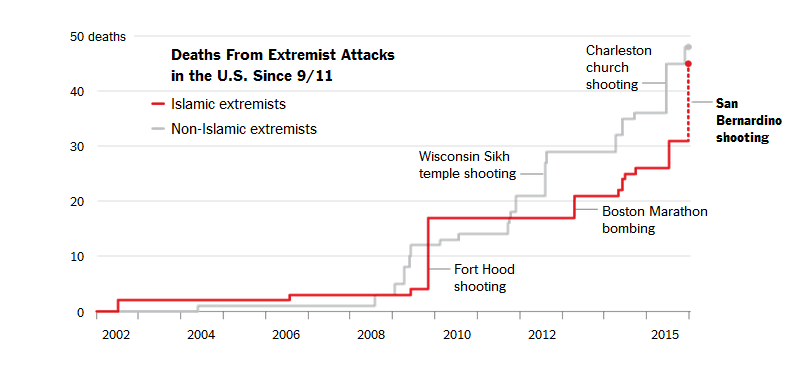
Islamic extremists, non-Islamic extremists, whatever. What gets my attention is the rapid growth since ca. 2008 in the overall number of deaths.
ADDENDUM 12/15/2015: FYI, you’re more likely to be fatally crushed by furniture than killed by a terrorist. Since 2001 and counting 9/11, there have been roughly 100x more firearms-related deaths in the US than there have been terrorism-related deaths. If you start counting after 9/11 then there have been about 1000x more firearms-related deaths than terrorism-related deaths.