Alternatives

Dan Charles, By Returning To Farming’s Roots, He Found His American Dream:

Eighteen years ago, on New Year’s Eve, David Fisher visited an old farm in western Massachusetts, near the small town of Conway. No one was farming there at the time, and that’s what had drawn Fisher to the place. He was scouting for farmland.

“I remember walking out [to the fallow fields] at some point,” Fisher recalls. “And in the moonlight – it was all snowy – it was like a blank canvas.”

On that blank canvas, Fisher’s mind painted a picture of what could be there alongside the South River. He could see horses tilling the land – no tractors, no big machineryand vegetable fields, and children running around.

This is David Fisher’s American Dream. It may not be the conventional American Dream of upward economic mobility. But dreams like his have a long tradition in this country. Think of the Puritans and the Shakers and the Amish. These American dreams are the uncompromising pursuit of a difficult ideal.

The scene that David Fisher imagined, on the New Year’s Eve almost two decades ago, has turned into reality. It’s called Natural Roots Farm.

Continue reading

Thought for the Day – October 7, 2016

Suppose a candidate for high office stood up and said “We face many difficult collective action problems. Here’s how I suggest we address them…” Suppose he was a Senator from Vermont named Bernie Sanders.  He’d get looked at like he had three heads.  He’d get called a communist and worse.  Until there’s widespread acknowledgement that we face collective action problems we’re unlikely to make much progress towards resolving them. We’ve been subject to decades of propaganda that there’s no such thing as a collective action problem. Just getting to acknowledgement that there are is a major challenge.

The Answer

The Answer

Then what is the answer? Not to be deluded by dreams.
To know that great civilisations have broken down into violence,
and their tyrants come, many times before.
When open violence appears, to avoid it with honor or choose
the least ugly faction; these evils are essential.
To keep one’s own integrity, be merciful and uncorrupted
and not wish for evil; and not be duped
By dreams of universal justice or happiness. These dreams will
not be fulfilled.
To know this, and know that however ugly the parts appear
the whole remains beautiful. A severed hand
Is an ugly thing and man dissevered from the earth and stars
and his history … for contemplation or in fact …
Often appears atrociously ugly. Integrity is wholeness,
the greatest beauty is
Organic wholeness, the wholeness of life and things, the divine beauty
of the universe. Love that, not man
Apart from that, or else you will share man’s pitiful confusions,
or drown in despair when his days darken.

Robinson Jeffers, 1935

Thought leaders

I hate the term “thought leaders”, perhaps because most of those considered such are lightweights.  Be that as it may, hearing the term for the n-th time the other day got me thinking about whose writing has been most influential on my thinking.  In no particular order:  Christopher Lasch, Noam Chomsky, Hunter S. Thompson, and Robert Adams.

I read a lot of Lasch 20-25 years ago.  His critiques of materialism and the liberal notion progress were spot on.  They remain so.  Agree or disagree with Chomsky’s politics, he sets an example for how to think critically about political power and its application.  Thompson got greed and the darker side of human behavior.  He’s a good complement to Chomsky in terms calling out both subtle and unsubtle uses of power for nefarious ends.  “Fear and Loathing on the Campaign Trail ’72” is one of the best books I’ve ever read.  Robert Adams makes the list for articulating an aesthetic sensibility in “Beauty in Photography”.

Thought for the Day: February 9, 2016

From an email correspondence a couple months back last year:

There’s a whole philosophy of “change theory” about what actually helps people cultivate change in their lives and what doesn’t that I think we (especially in Puritan New England!) sometimes forget about.  Deep change is slow, involves lots of false starts and short retreats alongside the exciting times of progress.  In order to sustain commitment to deep change, there must be a sense of joy simply in one’s commitment to the goal of deep change.  This joy inspires us to take risks, and it keeps us from being too harsh on ourselves when we face setbacks. 

I’m not predisposed to joy, which makes that challenging for me, but I believe he’s absolutely correct.

The ethics of cyber-enhancements

Transhumanism, n.:  The belief or theory that the human race can evolve beyond its current physical and mental limitations, especially by means of science and technology.

Cyborg, n.:  a person whose body contains mechanical or electrical devices and whose abilities are greater than the abilities of normal humans

Humanity, n.:  the quality or state of being human

There are two blogs that I check every day, Brad DeLong’s Grasping Reality with Both Hands and Mike the Mad Biologist.   The other day Brad had a post, (Early) Monday Idiocy: Chris Bertram Wages War on Eyeglasses, Surrenders to Cyborgs.  It was a critique of a critique of a post by econoblogger Noah Smith, Rise of the Cyborgs.  You can follow the links if you’re interested in the details.  The purpose of this post is to clarify comments I left on DeLong’s blog, respond to questions and criticisms, and to provide another forum for continuing the discussion.

Continue reading

Climate Moment

I am a scientist. My work requires that I understand atmospheric physics and some chemistry as well as a healthy dose of applied mathematics and statistics. Over the past 25 years I’ve picked up enough climate science that I have a pretty good idea of what’s coming should we choose to maintain the status quo with respect to fossil fuel consumption and carbon dioxide emissions. I am not given to false hopes. I think often of a passage from Dougald Hine’s essay, “What do you do, after you stop pretending?” Hine writes:

‘Changing the world’ has become an anachronism: the world is changing so fast, the best we can do is to become a little more observant, more agile, better able to move with it or to spot the places where a subtle shift may set something on a less-worse course than it was on. And you know, that’s OK – because what makes life worth living was never striving for, let alone reaching, utopias.

There’s a big difference between the task of trying to sustain “civilisation” in its current form … which is what “sustainability” has largely come to mean, and the task of holding open a space for the things which make life worth living. I’d suggest that it’s this second task, in its many forms, which remains, after we’ve given up on false hopes.

Hine’s passage stays with me. We need to hold open that space.

For me, flowers are one of the things that make life worth living. I feel strongly enough about it that I plant wildflowers. I started off some years ago planting New-England-native species but last year I switched my focus to prairie wildflowers. In addition to their beauty and their appeal to bees and other pollinators, I am drawn to their resilience. They put down roots three feet, four feet, or more. They tolerate extreme heat and drought. That, I believe, is significant.

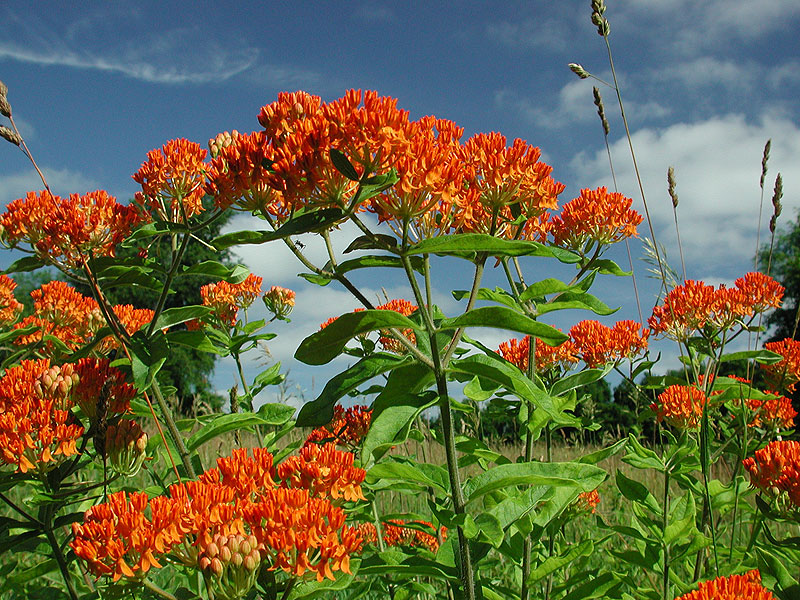
Last summer our Asclepias tuberosa – otherwise known as “butterfly weed” – was in full bloom. Butterfly weed is a cousin of milkweed. It is shorter – a bit above knee height – with small orange star-shaped flowers. It is far and away our most popular flower with the bees and butterflies. One hazy Saturday afternoon in July my four-year-old son and I walked down our garden pathway and sat down between two large patches of it. When we sat the flowers were over our heads. The blossoms were teeming with bees. We watched and listened for a few minutes. In the moments in between the sound of passing cars, the hum of the bees filled the space around us. It was not a dramatic moment but is one which will stay with me.

There’s a big difference between the task of trying to sustain civilization in its current form and the task of holding open a space for the things which make life worth living. When it comes to climate change, we can each find our place on the continuum from comprehension to commitment to action. I may not be at a place in my life where I can engage in civil disobedience in order to block construction of a natural gas pipeline, but I can develop compassion for and be supportive of those who do. And I can make time to plant wildflowers which set deep roots and to sit with my kids and watch the bees.
010624_083640-butterfly_milkweed

Continue reading

Thought for the Day: 2 November 2015

We are surrounded by objects which are, it is true, efficient but they are absolutely pointless. A work of art, on the other hand, has meaning in various ways or it calls up in me a feeling or an emotion whereby my life acquires sense. That is not the case with a technological product. We have the obligation to rediscover certain fundamental truths which have disappeared because of technology. We can also call these truths values, important, actual values, which ensure that people experience their lives as having meaning.

Jacques Ellul