LearnEO!

LearnEO! is a creation of the European Space Agency.  From the LearnEO! website:

LearnEO! is an Earth observation education project funded by the European Space Agency. Its aim is to increase the understanding of satellite data from ESA missions and show how these can be used to tackle environmental problems in the real world.

The project will develop hands-on training resources for use primarily (but not exclusively) by teachers and students at upper high school to university level.


The Trans-Pacific Partnership (TPP) – “Kill it with fire.”

Updated 10/17/2015.

Current status of the TPP:  The agreement has been negotiated. Now it goes to Congress for an up or down vote.  It cannot be amended.  In theory, it could get voted down.  In practice, I’m not holding my breath.

News and posts:

Continue reading

Change comes to Greece

Syriza, the left-wing anti-austerity party, appears to have won a big plurality in the Greek general election.   From the BBC:

Polls suggested Syriza took between 35.5% and 39.5% of total votes. The ruling New Democracy party came a distant second with 23%-27% of the total vote.  It is unclear whether Syriza has enough votes to govern the country alone.  Syriza’s Alexis Tsipras has pledged to renegotiate Greece’s debt arrangement with international creditors.  He has also vowed to reverse many of the austerity measures adopted by Greece since a series of bailouts began in 2010.  The result is being closely watched outside Greece, where it is believed a Syriza victory could encourage radical leftist parties across Europe.

We’ll see how that shakes up the Euro zone.

Weekly Digest – January 25, 2015

Must Read/Listen

Should Read/Watch

Continue reading

The nine planetary boundaries

From the Stockholm Resilience Center:

Today, 60 per cent of the free ecosystem services that we use are exploited in an unsustainable manner.

Crucial ecosystem services such as air- and water purification, the pollination of crops and the seas’ capacity to produce fish are in serious decline. The changes are occurring so rapidly today that society is unable to adapt to the new environmental circumstances and thus cannot effectively develop strategies and frameworks for sustainable use of the ecosystems.

“Our societies are an integrated part of the biosphere and dependent upon functioning ecosystems. That is why we need to manage ecosystems so that we can handle the future’s challenges and maintain our capacity to evolve in a positive way,” says Carl Folke.

With that in mind:

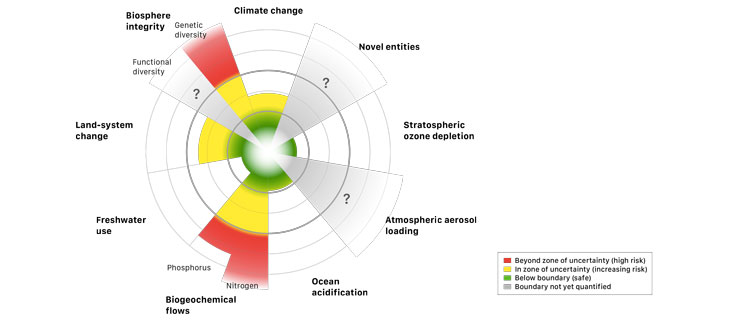
The [Planetary Boundaries] framework was first introduced in 2009, when a group of 28 internationally renowned scientists identified and quantified the first set of nine planetary boundaries within which humanity can continue to develop and thrive for generations to come. Crossing these boundaries could generate abrupt or irreversible environmental changes. Respecting the boundaries reduces the risks to human society of crossing these thresholds.

The nine are:

  1. Stratospheric Ozone Depletion
  2. Loss of biosphere integrity (biodiversity loss and extinctions)
  3. Chemical pollution and the release of novel entities
  4. Climate Change
  5. Ocean acidification
  6. Freshwater consumption and the global hydrological cycle
  7. Land system change
  8. Nitrogen and phosphorus flows to the biosphere and oceans
  9. Atmospheric aerosol loading

Here’s where the Center rates humanity with respect to each:

PB_FIG33_media_11jan2015_web2

Thought for the Day: 23 January 2015

Joe Stiglitz, The Politics of Economic Stupidity:

[L]ow interest rates will not motivate firms to invest if there is no demand for their products. Nor will low rates inspire individuals to borrow to consume if they are anxious about their future (which they should be)…. Demand is what the world needs most. The private sector – even with the generous support of monetary authorities – will not supply it. But fiscal policy can. We have an ample choice of public investments that would yield high returns – far higher than the real cost of capital – and that would strengthen the balance sheets of the countries undertaking them.

The big problem facing the world in 2015 is not economic. We know how to escape our current malaise. The problem is our stupid politics.

The Inadequacy of the Obama Administration, Part… I’ve Lost Count

From Bob Kuttner, The Politics of Gesture:

Among the measures [Pres. Obama proposed which require] legislation is a tax plan that would increase taxes on the wealthiest in order to finance the tuition help for community college students and more generous child tax credits for working families. Obama also wants an excise tax on large banks and he is calling on Congress to pass a law giving all workers seven days of annual sick leave….

[Pres. Obama’s] initiatives are welcome. It probably sounds churlish to say that measures such as [he proposed] should have come much earlier in his presidency, and could have been a lot stronger.

The measures Pres. Obama proposed in his SOTU address should have come much earlier in his presidency, and could have been a lot stronger.  Back to Mr. Kuttner (emphasis mine):

Late in the game, when there is no risk that his proposals will be enacted, Obama is belatedly pursuing policies that seek to underscore the differences between Democrats and Republicans in terms of the practical situation of regular people…

The time to have fought for such policies was when Obama still had a majority in Congress. But back then, in 2010, he was promoting deficit reduction.

And there are two deeper problems. None of Obama’s proposals will fundamentally change the distribution of wealth and power in America. None addresses the structural erosion of decent payroll jobs.

Continue reading