
[Mr. Putin] is proud, emotional, aggrieved and shrewd — historically a dangerous combination. His skills, well-honed at the K.G.B., include a perfected ability to obfuscate and divide.
Author Archives: Chris
Music for Monday night
The TPP is a really bad deal – Part 5, What part of getting kicked in the face do you not understand?
Dean Baker, Getting It Wrong on Trade: TPP Is Not Good for Workers (emphasis mine):
The big money is sweating big time since it seems large segments of the American public have caught wind of the Obama administration’s plans for the Trans-Pacific Partnership. After several decades in which trade has been a major factor depressing the wages and living standards of the country’s workers, the Obama administration is going back to the well to push for more….
Many prominent economists, including many strongly pro-trade economists… have argued the TPP should include rules on currency manipulation… According to calculations by Bergsten and others, actions of foreign central banks to raise the value of the dollar have added several hundred billions of dollars to our trade deficit and cost us millions of manufacturing jobs.
Weekly Digest – The Ides of March, 2015
Must Read
- James Fallows, One of Our Major Newspapers Says: What the Hell, Why Not Start Another Unwinnable War?
- Robert Kuttner, Can Liberal Democracy Survive?
- Elise Gould, Not a Puzzle—Wages Growth is Sluggish Because Employers Hold All the Cards
Should Read
- Elise Gould, There Are Nearly Six Unemployed Construction Workers for Every Construction Job Opening
- Lydia DePillis and Jim Tankersley, To fix inequality, Democrats are pushing unions
- Paul Krugman (NYT), Slandering the 70s
- Robert Kuttner, Will the Fed Kill the Recovery Again?
- Robert Reich, The conundrum of corporation and nation
- driftglass, King Cotton: Party Like It’s 1862 [Ed.: Republican idiocy
on Iran.]
Republican Idiocy on Iran
- NY Times Editorial Board (NYT), Republican Idiocy on Iran
- Greg Jaffe, Who are the seven Republicans who didn’t sign the Iran letter?
Bipartisan Idiocy on Iran
- Ray Edroso, Gulf War III – Third Time’s the Charm
War
- Sarah Everts, When Chemicals Became Weapons of War
- Sergio Pecanha, Jeremy White and K.K. Rebecca Lai (NYT), Syria After Four Years of Mayhem
- Paul Waldman, Kicking the Iraq Syndrome On the Way to Tehran
Jennifer Francis, Understanding the Jetstream
Music for Saturday night
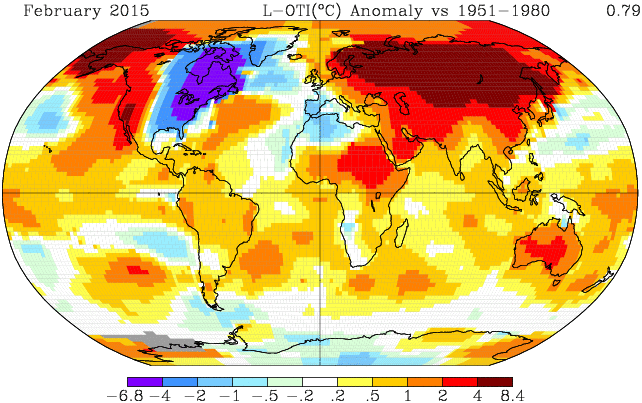
Yup. February was mighty cold in these parts.
NAFTA was a bad deal for U.S. workers. That’s one of the reasons I expect bad things from the TPP.
I’ve made multiple TPP-related posts of the past months – find them as well as older ones here. (Just click the “TPP” tag over on the right.) In terms of what we might expect if the TPP is enacted, it’s worth looking back at NAFTA and it’s consequences. NAFTA was enacted in 1994 under Pres. Clinton. From my perspective, Ross Perot got it right was accurate with his prediction. It’s turned out to be an awful deal – an estimated 700,000 U.S. jobs lost.
Economic Policy Institute (EPI) economist Jeff Faux and UC-Berkeley economist Brad DeLong had a public exchange last summer re the merits of NAFTA – Faux taking the position that it’s turned out to be a bad deal and DeLong taking the position that it’s been a net benefit:
- Jeff Faux, NAFTA, Twenty Years After: A Disaster
- Brad DeLong, Was NAFTA a Disasta?: Wednesday Focus for July 30, 2014
- Jeff Faux, The Neoliberal Mind at Work: Brad DeLong’s Muddled Defense of NAFTA
And Robert Scott of EPI adds his two cents on Faux vs DeLong:
If you’re an investor I can see why you might view NAFTA favorably. If you live in the U.S. and work for a living I do not see how you could view it favorably.
(For what it’s worth, I’ve cited DeLong favorably dozens of times. NAFTA and his inclination to support the TPP are rare – but predictable – instances where I believe he is badly wrong.)
The Trans-Pacific Partnership is a bad deal – Part 4
Dean Baker with an assessment of the economics in “Fun With Brad DeLong on TPP“:
Brad thinks he has a winner policy with TPP, taking issue with Paul Krugman who says the deal is not worth doing. Brad argues that even if the deal is worth half of the 0.5 percent of GDP figure that is widely cited, we are still talking about 0.25 percent of GDP, or $75 billion a year for the region as a whole and $45 billion for the U.S.
He acknowledges that these gains may not be spread evenly, but wants to see evidence that the losses to workers would be larger than their share of this $75 billion. He also notes Krugman’s complaint about increased protection for intellectual property, especially drug patents, and wants to see evidence that these losses will be large enough to offset the $75 billion in annual gains. Okay, let’s take the DeLong challenge.
Samuel Florman, “Nice Work”
From Samuel Florman’s “Nice Work”, originally published in the May 1976 issue of Harper’s:
What do people want out of life? That is one of those questions whose answer can be shaped by the way in which the question is posed. Straightforward statistical studies find that job discontent is not high on the list of American social problems. When the Gallup poll’s researchers ask, “Is your work interesting?” they get 80 to 90 percent positive responses. But when researchers begin to ask more sophisticated questions, such as “What type of work would you try to get into if you could start all over again?” complaints begin to pour forth. The probing question cannot help but elicit a plaintive answer. Which of us, confronted with a sympathetic organizational psychologist, or talking into Studs Terkel’s tape recorder, could resist tingeing our life’s story with lamentation, particularly if that was what the questioner was looking for? Compared to the “calling” that Terkel says we are all seeking, what job could measure up?