Forty years ago yesterday
Author Archives: Chris
Climate Moment
I am a scientist. My work requires that I understand atmospheric physics and some chemistry as well as a healthy dose of applied mathematics and statistics. Over the past 25 years I’ve picked up enough climate science that I have a pretty good idea of what’s coming should we choose to maintain the status quo with respect to fossil fuel consumption and carbon dioxide emissions. I am not given to false hopes. I think often of a passage from Dougald Hine’s essay, “What do you do, after you stop pretending?” Hine writes:
‘Changing the world’ has become an anachronism: the world is changing so fast, the best we can do is to become a little more observant, more agile, better able to move with it or to spot the places where a subtle shift may set something on a less-worse course than it was on. And you know, that’s OK – because what makes life worth living was never striving for, let alone reaching, utopias.
There’s a big difference between the task of trying to sustain “civilisation” in its current form … which is what “sustainability” has largely come to mean, and the task of holding open a space for the things which make life worth living. I’d suggest that it’s this second task, in its many forms, which remains, after we’ve given up on false hopes.
Hine’s passage stays with me. We need to hold open that space.
For me, flowers are one of the things that make life worth living. I feel strongly enough about it that I plant wildflowers. I started off some years ago planting New-England-native species but last year I switched my focus to prairie wildflowers. In addition to their beauty and their appeal to bees and other pollinators, I am drawn to their resilience. They put down roots three feet, four feet, or more. They tolerate extreme heat and drought. That, I believe, is significant.
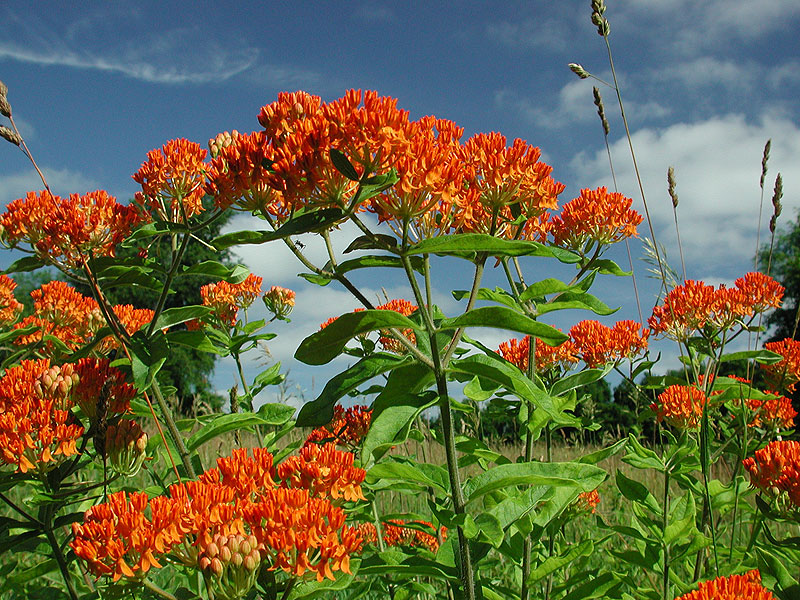
Last summer our Asclepias tuberosa – otherwise known as “butterfly weed” – was in full bloom. Butterfly weed is a cousin of milkweed. It is shorter – a bit above knee height – with small orange star-shaped flowers. It is far and away our most popular flower with the bees and butterflies. One hazy Saturday afternoon in July my four-year-old son and I walked down our garden pathway and sat down between two large patches of it. When we sat the flowers were over our heads. The blossoms were teeming with bees. We watched and listened for a few minutes. In the moments in between the sound of passing cars, the hum of the bees filled the space around us. It was not a dramatic moment but is one which will stay with me.
There’s a big difference between the task of trying to sustain civilization in its current form and the task of holding open a space for the things which make life worth living. When it comes to climate change, we can each find our place on the continuum from comprehension to commitment to action. I may not be at a place in my life where I can engage in civil disobedience in order to block construction of a natural gas pipeline, but I can develop compassion for and be supportive of those who do. And I can make time to plant wildflowers which set deep roots and to sit with my kids and watch the bees.
Weekly Digest – November 8, 2015
Must Read
- Matt Taibbi, The Case for Bernie Sanders
- Sally Jacobs, As Vermont official, Sanders ‘Got things done’
- Mark Thoma, commentary on WSJ article ‘Economic Policy Splits Democrats’
- Dave Johnson, What To Look For When the Trans-Pacific Partnership Text Is Released
Should Read
- Office of the U.S. Trade Representative, [Trans-Pacific Partnership] Full Text
- Claire Cain Miller (NYT), Stressed, Tired, Rushed: A Portrait of the Modern Family
- Charlie Pierce, 420,000 Kentuckians May Have Just Had Their Healthcare Voted Away
- Cardinal Peter Turkson, Lecture on ‘Laudato Si’
- Charlotte Du Cann, Portrait of an Edition [Ed.: Summary of The Dark Mountain Project’s issue no. 8.]
Thought for the Day: 2 November 2015
We are surrounded by objects which are, it is true, efficient but they are absolutely pointless. A work of art, on the other hand, has meaning in various ways or it calls up in me a feeling or an emotion whereby my life acquires sense. That is not the case with a technological product. We have the obligation to rediscover certain fundamental truths which have disappeared because of technology. We can also call these truths values, important, actual values, which ensure that people experience their lives as having meaning.
Weekly Digest – November 1, 2015
Must Read
- Rep. Ken Gordon Leads Charge: Committee Hears Paid Family and Medical Leave Bill [Ed.: If you live in Bedford, Burlington, or the right corner of Wilmington then Ken is your State Rep. He’ll be up for re-election next year. If you don’t know him already then get to know him. He’s excellent – as committed a public servant as you’ll ever meet.]
- Ron Hira, Disney H-1B Scandal in Spotlight Again: Meet The American Workers Whose Jobs and Careers Were Destroyed by the H-1B Program
- Chris Dillow, On Misunderstanding Economics
- Brian Beutler, The GOP’s Grotesque Festival of Lies
Should Read
- Rick Perlstein, The GOP Circus: Truth-Defying Feats [Ed.: “Poor old John Kasich” indeed.]
- David Herszenhorn (NYT), House Approves Budget, Providing ‘Clean’ Exit That John Boehner Sought
- Dean Baker, Paul Ryan Wants to Shut Down the Government, Permanently
- Jessica Silver-Greenberg and Robert Gebeloff (NYT), Arbitration Everywhere, Stacking the Deck of Justice
- We Mapped the Uninsured. You’ll Notice a Pattern.
- Andrew Bacevich, Yes, the U.S. can leave Afghanistan
- Eli Rabett, Need to Know
Music for Halloween
Music for Friday night
Music for Thursday night
The Geometric Mean Theory of Executive Leadership
Weekly Digest – October 25, 2015
Must Read
- The Bedford Citizen, “Carbon Pricing” Takes Center Stage at [Massachusetts] State House Hearing at 1 pm on Tuesday, October 27
- Francis Wilkinson, Republicans Gone Wild: Q&A with [Thomas] Mann and [Norm] Ornstein
- Matt Taibbi, Trey Gowdy Just Elected Hillary Clinton President
Should Read
- driftglass, Final Update: At The Pillory Clinton Hearing [Ed.: A translation of the Benghazi hearing transcript from the original Bullshit.]
- NYT Editorial Board (NYT), A New Attack on Health Care Reform
- Andrew Gelman, Ta-Nehisi Coates, David Brooks, and the ‘Street Code’ of Journalism
- Ben Jackson, 4 Months And Counting: Lessons From Homelessness
- Josh Barro (NYT), Bernie Sanders, Democratic Socialist Capitalist
- Harold Meyerson, Why Democrats Need Both Sanders and Clinton